How to prevent porosity specifically in aluminum castings?
Porosity is one of the most prevalent flaws in the manufacture of aluminium casting parts, which reduces strength and pressure tightness. To prevent this, the underlying reasons need to be addressed. Hydrogen absorption, shrinkage, and process factors. This book deals with practical methods in melting, mould design, pouring, and inspection for the production of sound aluminium casting parts.
What Causes Porosity in Aluminium Casting Part Production and How Can It Be Eliminated?
Hydrogen Gas Absorption During Melting
Hydrogen solubility in liquid aluminium far exceeds that in solid metal, so dissolved gas forms spherical pores within the aluminium casting part during solidification. Moisture, damp crucibles, and contaminated scrap drive hydrogen pickup. Eliminating this requires dry equipment, minimized superheat, and rotary degassing with argon or nitrogen before pouring each aluminium casting part.
Shrinkage Porosity from Improper Feeding
Aluminium alloys shrink approximately 6 percent during solidification. When feeding paths are inadequate, shrinkage creates irregular cavities inside the aluminium casting part. Proper riser placement, chills, and directional solidification ensure molten metal feeds shrinking areas. Engineers design gating so each aluminium casting part solidifies progressively from extremities toward feeders, maintaining adequate liquid metal supply throughout the solidification range.
Aluminium Casting Part Defects Explained: Gas Porosity, Shrinkage, and Process Optimization
Distinguishing Gas Porosity from Shrinkage Porosity
Accurate defect identification guides remediation. Gas porosity appears as small, round, bright-walled bubbles distributed throughout the aluminium casting part, often on machined surfaces. Shrinkage porosity presents as jagged, branching cavities at thermal centers. Metallographic and radiographic testing distinguish these types. Knowing whether an aluminium casting part suffers gas or shrinkage porosity directs corrective actions appropriately.
Process Optimization to Minimize Porosity
Optimizing casting parameters reduces porosity in every aluminium casting part. Key variables include pouring temperature, mold preheating, grain refinement, and cycle timing. Excessive pouring temperatures increase hydrogen absorption, while low temperatures cause premature solidification. Grain refiners like titanium-boron promote fine equiaxed grains resisting shrinkage. Controlling these parameters ensures each aluminium casting part achieves consistent density across production batches.
How Do Mold Design, Degassing, and Melt Treatment Improve Aluminium Casting Part Quality?
Mold Design for Porosity Prevention
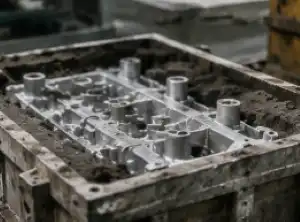
The basic design of the mould has an impact on the porosity of any aluminium casting item. The proper gating geometry regulates the flow velocity to avoid turbulence that entrains air. Riser size and location must provide ample feeding metal for shrinkage. Solidification progression determined by cooling channel configuration. Simulation software allows designers to detect hot spots before manufacturing, so they may optimise every single mould of aluminium casting parts to minimise the possibility of porosity.
Rotary Degassing and Melt Treatment
The most effective melt treatment to reduce hydrogen levels in aluminium casting part manufacturing is rotary degassing. A revolving impeller strips dissolved hydrogen and disperses small inert gas bubbles across the melt. This and flux treatments for inclusion removal result in a cleaner melt. Each aluminium casting item is tested for reduced pressure to verify hydrogen levels and is also tested for density and radiography standards.
Aluminium Casting Part Manufacturing Guide: Casting Process, Inspection, and Quality Control
Gating System and Pouring Temperature Control
The gating mechanism regulates the flow of molten aluminium into the mould and immediately affects the porosity of the completed aluminium casting item. Bottom gated systems prevent turbulence and oxide entrainment. The sprue, runner, and ingate cross sections are required to have laminar flow. The pouring temperature should be optimised for fluidity, but minimise gas pick-up. Each aluminium casting component is solidified with minimum faults via accurate control.
Non-Destructive Testing for Porosity Detection
Multiple inspection techniques for quality control of aluminium casting part manufacturing. Automated defect identification via digital imaging in X-ray radiography for non-destructive detection of interior porosity. Ultrasonic testing detects subsurface cavities. Dye penetrant will show surface-connected porosity. The Archimedes technique of measuring density statistically verifies soundness and guarantees that each aluminium casting item fulfils required quality criteria before shipping.
How to Choose High-Quality Aluminium Casting Part Solutions for Automotive, Machinery, and Industrial Applications?
Alloy Selection and Application Requirements
The selection of the proper alloy is very important for a fault-free aluminium casting part. Al–Si alloys like A356 have very good fluidity and feeding, which also reduces shrinkage porosity. Heat-treatable Al-Si-Mg alloys for improved characteristics. Strontium alteration enhances pore morphology for automotive components for pressure tightness. Each application requires an aluminium casting part with a design that has alloy and porosity control appropriate to service circumstances.
Supplier Evaluation and Quality Assurance
You must choose a dependable provider to guarantee the quality of aluminium casting parts is stable. Key requirements include ISO 9001:2015 certification, documented process controls and metallurgical testing. Material certifications and radiography reports are to be provided by suppliers for each lot of aluminium casting parts. Established in 2001, Welong delivers customised aluminium casting part solutions from drawing to over 100 worldwide clients with its ISO certified quality procedures.
Conclusion
In aluminium casting part manufacturing, porosity prevention requires a complete strategy including melt treatment, mould design, process optimisation and inspection. Good castings are produced by regulating the hydrogen by degassing, planning for directed solidification, and quality control by the producers. Welong, 20+ Years Experience, ISO 9001: 2015 Certified, Trusted Name in Precision Aluminium Casting Part Solutions from Drawings, Empowering Industries Globally.
FAQ
Q1: What is the primary cause of gas porosity in an aluminium casting part?
A1: Gas porosity is mainly caused by hydrogen absorption during melting. Atmospheric moisture introduces hydrogen into molten aluminium, rejected during solidification as spherical bubbles. Rotary degassing with inert gases reduces dissolved hydrogen before casting.
Q2: How can shrinkage porosity be distinguished from gas porosity?
A2: Gas porosity appears as round, bright-walled bubbles throughout the aluminium casting part, while shrinkage porosity presents as jagged cavities at thermal centers. Radiographic testing and metallographic examination reliably distinguish the types.
Q3: What role does mold design play in preventing porosity?
A3: Mold design controls metal flow, feeding efficiency, and solidification direction. Proper gating reduces turbulence, while correctly sized risers provide feed metal for shrinkage. Simulation software optimizes mold design before production to minimize porosity in each aluminium casting part.
Q4: Which inspection methods detect porosity in aluminium casting parts?
A4: X-ray radiography detects internal porosity, while ultrasonic testing identifies subsurface voids. Dye penetrant reveals surface-connected porosity, and density measurement through the Archimedes method verifies overall casting soundness for every aluminium casting part.
Q5: Can Welong produce custom aluminium casting parts from drawings?
A5: Yes. Welong manufactures aluminium casting parts from drawings and samples using AutoCAD, Pro-Engineering, and SolidWorks. With ISO 9001:2015 certification and 20 years of experience, Welong serves over 100 international customers.
Ready to Source Defect-Free Aluminium Casting Parts?
With over 20 years serving customers across the UK, Germany, France, Italy, the USA, Canada, and Australia, Welong delivers precision aluminium casting part solutions backed by ISO 9001:2015 certification. Our engineering department designs and manufactures using AutoCAD, Pro-Engineering, and SolidWorks, accepting drawings and samples. We have shipped to more than 100 international automotive and industrial customers worldwide. Send your drawings today—contact us at info@welongpost.com and let Welong empower your supply chain with China's finest manufacturing.
References
1. Campbell, J. (2015). Complete Casting Handbook: Metal Casting Processes, Metallurgy, Techniques and Design. Butterworth-Heinemann, Oxford, UK.
2. ASM International. (2008). ASM Handbook Volume 15: Casting. ASM International, Materials Park, Ohio, USA.
3. Davis, J.R. (Ed.). (2001). Alloying: Understanding the Basics. ASM International, Materials Park, Ohio, USA.
4. Beeley, P. (2001). Foundry Technology. Butterworth-Heinemann, Oxford, UK.
5. Stefanescu, D.M. (2015). Science and Engineering of Casting Solidification. Springer, New York, USA.
6. Brown, J.R. (Ed.). (2000). Foseco Foundryman's Handbook. Butterworth-Heinemann, Oxford, UK.

Share your inquiry, get the quotation accordingly!
China WELONG- Your Reliable Partner in Metal Solutions