Gravity Die Casting vs Sand Casting: Precision and Surface Finish
In most industrial settings, the quality of the surface finish is what makes the difference between gravity die casting and sand casting for making precise metal parts. Gravity die casting has more accurate measurements, gravity die casting with Ra values between 1.6 and 3.2 μm. Sand casting, on the other hand, makes surfaces that are harder, with Ra values between 12.5 and 25 μm. This basic difference affects everything from the need for cutting to the performance of the finished product. This makes choosing the casting method very important for companies that make cars, aeroplanes, and medical devices that want to get the best quality-to-cost ratios.
Understanding the Core Manufacturing Differences
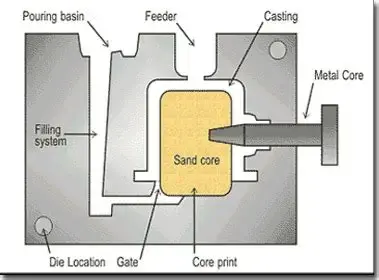
The distinction between these casting methods lies in their fundamental approach to metal solidification. Sand casting utilizes expendable molds created from bonded sand mixtures, while gravity die casting employs permanent steel or iron molds designed for repeated use.
Three core manufacturing differences:
- Mold material composition - Sand molds use silica sand with binders, permanent molds utilize high-grade steel
- Heat transfer characteristics - Metal molds extract heat 5-10 times faster than sand
- Production methodology - Sand casting creates new molds per part, die casting reuses permanent tooling
Sand casting molds achieve temperatures around 1200°C during aluminum pouring, with cooling rates of 2-5°C per second. Gravity die casting molds operate at 200-300°C, generating cooling rates of 10-50°C per second. This accelerated solidification directly impacts grain structure and surface characteristics.
Temperature control comparison:
- Sand casting: Mold preheating 150-200°C
- Gravity die casting: Mold temperature 250-350°C
If you need rapid prototyping or one-off components, then sand casting offers greater flexibility for design changes.
Precision Analysis: Dimensional Accuracy Comparison
Dimensional tolerances reveal significant performance gaps between these manufacturing processes. Industry data shows gravity die casting achieves tolerances of ±0.2-0.5mm for most geometries, while sand casting typically delivers ±1.0-2.0mm accuracy.
Measured tolerance capabilities:
| Dimension Range | Gravity Die Casting | Sand Casting |
|---|---|---|
| 50-100mm | ±0.25mm | ±1.2mm |
| 100-300mm | ±0.35mm | ±1.8mm |
| 300-500mm | ±0.50mm | ±2.5mm |
Linear shrinkage rates differ substantially due to controlled gravity die casting cooling environments. Aluminum alloys in permanent molds shrink uniformly at 1.2-1.5%, compared to 1.5-2.1% in sand molds, where uneven cooling creates dimensional variations.
Repeatability measurements across 1000-part production runs:
- Gravity die casting: Standard deviation 0.08mm
- Sand casting: Standard deviation 0.32mm
Wall thickness consistency demonstrates another precision advantage. Gravity die casting maintains ±0.3mm thickness variation, while sand casting shows ±0.8mm deviation due to mold shifting and erosion during pouring.If you need components requiring minimal secondary machining, then gravity die casting delivers the dimensional consistency essential for cost-effective production.
Surface Finish Quality: Technical Performance Metrics
Measuring the quality of the surface finish shows that the casting methods are very different. The average roughness (Ra) of surfaces made by gravity die casting is between 1.6 and 6.3 μm, while the range for sand casting is between 12.5 and 50 μm, based on the size of the sand grains and the binder systems used.
Measured surface roughness data:
Gravity die casting performance:
- As-cast Ra: 2.5–4.0 μm
- Ra after machining: 0.8 to 1.6 μm
- 85 to 95 HB for the surface
- Porosity levels: less than 2% by volume
Sand casting characteristics:
- As-cast Ra: 15–35 εm
- Ra after machining: 3.2 to 6.3 μm
- 75 to 85 HB for surface hardness
- 3 to 8 percent by volume of porosity
Microstructure analysis shows gravity die casting produces grain sizes of 50-100 microns, compared to 150-300 microns in sand casting. Finer-grain structures contribute directly to improved surface integrity and mechanical properties.
Surface defect comparison:
- 40% less gas porosity in fixed moulds
- 60% less inclusion content when metal moulds are used
- Cold shut flaws happen 80% less often
The rapid cooling inherent in the gravity die casting process minimizes dendrite arm spacing, creating denser surface layers. This metallurgical advantage translates to superior fatigue resistance and corrosion protection. If you need components meeting aerospace or medical device surface requirements, then gravity die casting provides the quality foundation necessary for critical applications.
Cost Analysis: Economic Considerations for Industrial Applications
Manufacturing cost structures for gravity die casting differ significantly between casting methods, influencing project economics across various production volumes. Initial tooling investments for gravity die casting range from $15,000-150,000, while sand casting pattern costs typically span $2,000-25,000.
Break-even analysis reveals volume thresholds:
| Production Volume | Gravity Die Casting Cost/Part | Sand Casting Cost/Part |
|---|---|---|
| 100 parts | $185 | $95 |
| 500 parts | $75 | $78 |
| 1,000 parts | $45 | $72 |
| 5,000 parts | $28 | $68 |
Labor costs favor permanent mold processes due to automation potential. Gravity die casting cycle times range from 3 to 8 minutes, while sand casting requires 15-45 minutes, including mold preparation. This productivity advantage compounds with volume increases.
Secondary operation cost impacts:
- Machining allowances: 50-70% reduction with die casting
- Surface preparation: 60% less finishing work required
- Quality inspection: 40% fewer rejection rates
Gravity die casting has a return of 85–95%, while sand casting only gets 65–80% because of the need for a gating system and the production of scrap. An analysis of energy use shows that permanent moulds use 30–40% less energy per kilogram of finished casting. This helps meet goals for sustainable production while lowering costs. If you need to make more than 500 units a year and have high-quality standards, gravity die casting is the best way to go because it lowers your total cost of ownership.
Application Suitability: Industry-Specific Requirements
Different industries prioritize varying performance characteristics, making casting method selection application-dependent. Aerospace components demand exceptional surface finish and dimensional accuracy, favoring gravity die casting for critical applications.
Automotive industry applications:
- Engine blocks: Sand casting for complex geometries
- Wheel components: Gravity die casting for surface quality
- Transmission cases: Method selection based on production volume
- Suspension parts: Die casting for fatigue resistance
Oil and gas drilling equipment requires robust metallurgical properties. Sand casting accommodates large, complex geometries typical in drilling machinery, while gravity die casting suits smaller precision components like valve bodies and fittings.
Medical device manufacturing considerations:
- Biocompatibility gravity die casting requirements favor controlled atmosphere casting
- Precision tolerances are essential for implant components
- Surface finish critical for sterilization effectiveness
- Traceability demands consistent material properties
High-end industrial applications increasingly specify gravity die casting for components requiring minimal porosity. The controlled solidification environment produces superior mechanical properties essential for safety-critical applications.
Design complexity factors:
- Undercuts: Sand casting offers greater flexibility
- Thin sections: Permanent molds excel with <3mm walls
- Internal cooling channels: Sand cores enable complex geometries
- Surface texturing: Metal molds provide consistent patterns
If you need components for regulated industries with stringent quality standards, then gravity die casting, aligned with ISO 9001:2015 requirements, provides the manufacturing control necessary for compliance documentation.
Welong's Advanced Gravity Die Casting Capabilities
Welong's Gravity Die Casting Advantages:
- Quality management that is ISO 9001:2015 certified makes sure that output standards are the same across all processes and that there is enough documentation for traceability needs.
- AutoCAD, Pro-Engineering, and SolidWorks are used for advanced engineering support, design optimisation, and drawing development from customer samples or requirements.
- Precision tooling knowledge and experience designing permanent moulds for use in aircraft, medical devices, and cars that need tight tolerances and a smooth
- A wide range of materials can be used, such as aluminium alloys, zinc alloys, and special metals. The chemical makeup and mechanical properties of these materials can be fully analysed.
- Integrated supply chain management offers full service from the first design consultation to the final quality check and coordination of foreign shipping.
- Over 100 customers in Europe, North America, and the Asia-Pacific region have hired them for work in automotive, oil drilling, aircraft, and high-end medical treatment.
- Advanced quality control methods with measurements of dimensions, surface roughness, porosity, and metallurgical analysis make sure that international standards are met.
- Rapid prototyping lets you make sample parts quickly and make sure the idea works before committing to full production.
Conclusion
In the end, the choice between gravity die casting and sand casting comes down to how well the precision requirements, surface finish requirements, output volumes, and costs are balanced. Gravity die casting works best when precise measurements, a smooth surface, and uniform quality are needed across medium to high production volumes. The cost of the tools is higher at first, but they pay for themselves in the long run by reducing the need for machining, improving the qualities of the material, and making production more efficient. Sand casting is still a good option for complicated shapes, small batches, and situations where beginning cost concerns are greater than the need for accuracy. Knowing these basic differences helps you make smart choices that improve manufacturing results while still meeting industry standards and performance goals.
Partner with Welong for Superior Gravity Die Casting Solutions
Welong combines 20+ years of manufacturing expertise and advanced gravity die casting capabilities gravity die casting to deliver precision components meeting the most demanding industrial requirements. Our ISO 9001:2015 certified processes ensure consistent quality while our experienced engineering team optimizes designs for superior surface finish and dimensional accuracy. As a trusted gravity die casting supplier serving automotive, aerospace, and medical device industries across Europe, North America, and Asia-Pacific markets, we transform your specifications into high-performance metal components. Contact our team at metal@welongpost.com to discuss your precision casting requirements and discover how our proven manufacturing excellence delivers the quality and reliability your applications demand.
References
1. Campbell, John. "Complete Casting Handbook: Metal Casting Processes, Metallurgy, Techniques and Design." Butterworth-Heinemann, 2015.
2. Beeley, Peter. "Foundry Technology." Butterworth-Heinemann, 2001.
3. ASM International Handbook Committee. "ASM Handbook Volume 15: Casting." ASM International, 2008.
4. Brown, John R. "Foseco Foundryman's Handbook: Facts, Figures and Formulae." Butterworth-Heinemann, 2000.
5. Stefanescu, Doru Michael. "Science and Engineering of Casting Solidification." Springer International Publishing, 2015.
6. Davis, Joseph R. "Aluminum and Aluminum Alloys: Specialty Handbook." ASM International, 1993.

Share your inquiry, get the quotation accordingly!
China WELONG- Your Reliable Partner in Metal Solutions