What Causes Forging Cracks in the Metal Forging Process?
Cracking is one of the most costly defects a manufacturer can encounter, often surfacing only after significant time and material have already been invested in a part. Understanding what drives crack formation in the metal forging process requires looking at the interaction between temperature, material quality, deformation strategy, and die design. This article breaks down the primary causes of forging cracks and outlines the process controls that help prevent them.
How Does Forging Temperature Affect Crack Formation?
Overheating and Hot Shortness
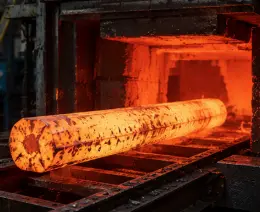
If a billet is heated above its permissible forging temperature, grain boundaries may be weakened by a process known as hot shortness, where low-melting-point elements segregate to boundaries and diminish cohesiveness. If the material is further deformed at this point, surface ripping often occurs. Tight furnace management is necessary to maintain each step of the metal forging process within a safe temperature window.
Underheating and Increased Flow Stress
The flow stress increases considerably with decreasing temperature, and the material will tend to resist deformation rather than flow smoothly into the die cavity. This extra resistance leads to higher internal strain concentration, especially at corners and thin portions. Consequently, underheated billets are far more prone to cracking than those forged within the appropriate range for their alloy composition.
Thermal Gradients Across the Workpiece
Uneven heating creates temperature differentials between the surface and core of a billet, causing different regions to deform at different rates. This mismatch generates internal stress that can manifest as cracking once the part is worked under pressure. Consistent, zone-controlled heating helps ensure uniform thermal conditions throughout the metal forging process.
Material Quality, Deformation, and Stress Concentration
Inclusions and Segregation in Raw Material
The pre-existing weak areas in the billet include non-metallic inclusions, porosity, or chemical segregation inherited from the casting step. These inclusions are sensitive to microcracking under compressive and shear stresses, and the cracks may spread outwards as the material is further deformed. Incoming material verification is a key point of defence before any part goes into the metal forging process.
Excessive Strain in a Single Pass
In the first forging stroke, too much deformation causes unequal distribution of the strain in the workpiece, and the strain exceeds the local limit of ductility of the material. This is a typical reason for cracks in geometrically complicated pieces when thin ribs or abrupt transitions are strained disproportionately to the mass of the part.
Residual Stress from Prior Processing
Material that has been cold worked, machined, or improperly cooled may have residual internal stress, which will be carried into the forging procedure. This residual stress, added to the extra stress of forming, might drive certain areas beyond the point of fracture. This is why it is important to know the whole history of the billet before forging.
Can Poor Die Design and Material Flow Cause Forging Cracks?
Sharp Corners and Abrupt Section Changes
Stress concentration spots occur in cavities with sharp interior corners or quick changes in cross section, when metal is compelled to change the direction of flow fast. These geometric characteristics are one of the most prevalent reasons for cracking, and hence engineers utilise large fillets and gentle transitions wherever the part design would allow.
Improper Flash Design and Material Flow
In closed die operations, poorly proportioned flash can restrict material flow, forcing metal to fold or shear rather than fill the cavity smoothly. This disrupted flow pattern often results in laps or cracks near parting lines, reinforcing the need for careful flash land design tailored to each part's geometry within the metal forging process.
Worn or Misaligned Dies
Uneven pressure on the workpiece may be caused by worn dies beyond tolerance or misaligned dies during setup, which results in localised overloading in some places. Regular die inspection and maintenance programs capture this wear before it starts to produce faulty, crack-prone pieces on the floor.
How Can Process Control Prevent Cracks in Metal Forging?
Real-Time Temperature Monitoring
By installing infrared sensors and thermocouples throughout the whole forging process, operators can detect temperature anomalies before they impair part quality. Real-time monitoring with automatic furnace modifications guarantees that the material constantly stays within its ideal forming window for every batch that is processed through the metal forging process.
Incoming Material Certification and Traceability
Requiring certified mill test reports and batch traceability for every incoming billet ensures that chemical composition and cleanliness meet specifications before material ever reaches the press. This upstream quality control step catches many potential crack sources long before they could impact production.
Simulation-Based Die and Pass Design
Today, the forging simulation software enables engineers to simulate the distribution of strain, temperature development, and material flow before they cut any tool steel. The die shape and pass sequencing may be optimised proactively by identifying high-strain areas beforehand, hence considerably decreasing the risk of cracks occurring once production starts.
Conclusion
Forging cracks typically trace back to a combination of temperature control, material quality, and die design issues within the metal forging process. Since 2001, China Welong has helped global manufacturers manage these variables through ISO 9001:2015-certified supplier development, purchasing supervision, and quality control services, serving over 100 customers for 20 years. Partner with Welong to strengthen your incoming material quality and reduce costly forging defects.
FAQ
Q1: What is the most common cause of forging cracks?
A: Improper forging temperature, whether too high or too low, is one of the most frequent causes, since it directly affects grain boundary strength and material flow behavior.
Q2: Can cracks form even with high-quality raw material?
A: Yes, poor die design, excessive single-pass strain, or worn tooling can still cause cracks even when the starting material meets specification.
Q3: How can inclusions in raw material lead to cracking?
A: Inclusions act as internal stress concentrators, creating weak points where microcracks can initiate and propagate under forging pressure.
Q4: Does the maintenance really affect crack formation?
A: Yes, worn or misaligned dies apply uneven pressure, creating localized overloading that significantly increases the risk of cracking.
Q5: Can forging simulation software help prevent cracks before production?
A: Yes, simulation tools model strain and temperature distribution in advance, allowing engineers to adjust die design and pass sequencing proactively.
Reduce Forging Defects With Welong's Supply Chain Expertise
Preventing metal forging process cracks starts with sourcing reliable, well-certified material and partnering with a supplier who understands the full production chain. China Welong brings two decades of international experience, ISO 9001:2015-certified quality control, and engineering support using AutoCAD, Pro-Engineering, and SolidWorks to help you minimize defects and improve yield. Whether you need customized forged components for automotive, aerospace, or oil drilling applications, our team is ready to support your project from drawing to delivery. Contact us today at metal@welongpost.com and let Welong help protect your next production run.
References
1. American Society for Metals (ASM International), Metals Handbook: Forming and Forging, Volume 14.
2. Dieter, G. E., Mechanical Metallurgy, McGraw-Hill Education.
3. Byrer, T. G., Semiatin, S. L., and Vollmer, D. C., Forging Handbook, Forging Industry Association.
4. Altan, T., Ngaile, G., and Shen, G., Cold and Hot Forging: Fundamentals and Applications, ASM International.
5. Kalpakjian, S., and Schmid, S. R., Manufacturing Engineering and Technology, Pearson Education.
6. Lange, K., Handbook of Metal Forming, Society of Manufacturing Engineers.

Share your inquiry, get the quotation accordingly!
China WELONG- Your Reliable Partner in Metal Solutions