Sink Roll Performance: What Factors Affect Rolling Accuracy?
In hot-dip continuous galvanizing lines, the sink roll operates submerged in molten zinc at over 450°C, guiding steel strip through the bath and redirecting it toward the air knives. Every micron of misalignment and every degree of bearing wear can produce coating defects, thickness inconsistencies, or unplanned downtime. Understanding what governs sink roll accuracy is essential for any team aiming to maintain consistent output across production campaigns.
Understanding Sink Roll Function and Its Role in Metal Rolling
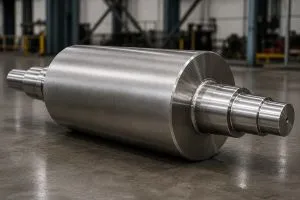
The sink roll actively shapes coating outcomes through three interdependent mechanical and hydrodynamic functions inside the zinc pot.
The Core Mechanism of Sink Roll in Continuous Galvanizing Lines
A sink roll redirects the strip upward, stabilizes it under tension to suppress vibration, and controls how molten zinc circulates the strip surface, directly governing coating distribution. If the sink roll loses rotational sync with line speed, visible drag marks appear immediately. These combined functions make the sink roll a hydrodynamic regulator whose precision determines final product quality rather than merely a passive turning component.
How Sink Roll Positioning Influences Zinc Coating Uniformity
The gap between sink roll and air knives defines the zinc recirculation zone where coating thickness takes shape. Position the sink roll too far from the knives, and gravity pulls excess zinc downward, thickening the lower strip section. Set it too close, and restricted flow causes surface scratches. Horizontal leveling matters equally: any tilt creates uneven strip tension, giving one edge more coating than the other. Sub-millimeter sink roll alignment errors produce coating variations detectable by measurement instruments and visual inspection alike.
Key Factors That Influence Sink Roll Accuracy
Accuracy depends on mechanical setup parameters and dynamic conditions that shift continuously during production runs.
Mechanical Alignment and Rotational Synchronization
The sink roll must stay perfectly parallel to the stabilizing rolls above it. Angular deviation disrupts tension profiles and zinc flow. Because strip friction drives the sink roll rather than a dedicated motor, its speed must match line speed exactly. When bearing resistance climbs, the sink roll slips against the strip, creating periodic scratches at intervals matching roll circumference. Accurate sink roll operation demands both static geometric verification and continuous dynamic monitoring to catch synchronization drift before defective material reaches the coiler.
Immersion Depth and Tension Control Parameters
Immersion depth sets the contact arc between the strip and the sink roll. Too shallow, and edges exit zinc prematurely, yielding thin coatings with incomplete alloy formation. Too deep, and bearing loads climb without coating benefit. Strip tension amplifies the effect because higher tension presses the strip harder against the sink roll surface, increasing friction and dross pickup. Production teams manage these interactions by mapping tension setpoints against line speed and gauge, adjusting sink roll position for consistent wrap angles across the product range.
How Material and Surface Quality Affect Rolling Performance
Material choices directly determine how long a sink roll holds dimensional accuracy in a chemically aggressive, high-temperature environment.
Base Material Selection for Long-Term Sink Roll Durability
Premium sink rolls use 316L stainless steel with controlled ferrite content to resist selective corrosion in molten zinc. Microstructural inconsistencies create preferential corrosion sites that grow into surface pits over multiple campaigns. Centrifugal casting produces finer, more uniform grain structures with fewer internal defects than static casting. A sink roll whose base metal carries inclusions or segregation zones develops localized wear that transfers onto the strip, producing recurring defects that worsen with each successive campaign.
Surface Coatings and Their Impact on Rolling Precision
Tungsten carbide coatings applied by high-velocity oxygen fuel spraying protect the sink roll surface. These coatings form a hard, chemically resistant barrier that reduces dross adhesion and slows degradation. The HVOF process yields dense, well-bonded layers with controlled porosity that endure thermal cycling and mechanical abrasion. A properly coated sink roll holds its surface finish longer, translating into fewer defects, more consistent strip contact, and extended intervals between scheduled roll changes under production conditions.
Common Issues That Reduce Sink Roll Efficiency
Even well-engineered sink rolls encounter problems. Recognizing failure patterns early lets teams intervene before accuracy degrades beyond acceptable limits.
Bearing Wear and Corrosion in High-Temperature Zinc Baths
Sink roll bearings face extreme conditions: submerged in molten zinc above 450°C with no conventional lubrication. Cobalt-based alloys like Stellite resist both chemical attack and mechanical wear. Degradation follows a predictable sequence: corrosion starts at surface irregularities, wear accelerates as clearance grows, and rotational smoothness declines until the sink roll drags against the strip. Once clearance exceeds specification, the entire sink roll assembly loses stability, and coating uniformity collapses rapidly across the strip width.
Dross Accumulation and Surface Degradation Challenges
Zinc dross forms when iron dissolves into molten zinc, creating intermetallic particles that stick to the sink roll surface. These deposits grow into high spots, imprinting periodic marks onto the coating with every rotation. The problem self-amplifies because rough surfaces attract more dross. Groove-clogging, where dross fills engineered surface channels meant to improve zinc flow, neutralizes a design feature intended to enhance sink roll performance. Effective dross management requires bath chemistry control combined with cleaning intervals calibrated to running alloy grades.
Maintenance Strategies to Ensure Consistent Rolling Accuracy
Sustained sink roll accuracy requires moving beyond reactive, calendar-driven servicing toward data-informed maintenance.
Predictive Maintenance and Tonnage-Based Replacement Scheduling
Leading operations track cumulative throughput tonnage instead of replacing sink roll components on fixed calendar dates. A sink roll processing 15,000 tons may show entirely different wear depending on product mix, line speed, and bath chemistry during its campaign. Maintenance systems automate this tracking and trigger work orders when a sink roll approaches empirically derived tonnage thresholds. This method extends campaign life by over 20% while cutting unplanned stoppages because interventions follow actual asset condition rather than arbitrary schedules.
Roll Shop Refurbishment and Dynamic Balancing Procedures
When a sink roll exits service, refurbishment sets the accuracy baseline for its next campaign. Procedures include precision grinding to restore geometry, documented bearing clearance measurement, and dynamic balancing to eliminate vibration sources. Each sink roll should meet a runout tolerance of 0.05 mm or better before returning to the zinc pot. Recording baseline vibration signatures builds a reference library that helps distinguish normal aging from emerging problems. A sink roll passing through disciplined refurbishment returns with restored accuracy potential.
Conclusion
Sink roll performance hinges on an interconnected chain: precise mechanical alignment, correct immersion geometry, quality base materials, durable surface coatings, and disciplined, data-driven maintenance practices. When any link in this chain weakens, rolling accuracy degrades in ways that are immediately measurable on the finished coated product. China Welong, founded in 2001, brings over two decades of industrial supply chain expertise to sourcing critical components, including sink rolls, for customers across automotive, aerospace, and manufacturing sectors worldwide. Our ISO 9001:2015 certified quality control processes ensure every component meets the exact dimensional and material specifications that sustain production accuracy demands.
FAQ
Q1: What is the primary function of a sink roll in a galvanizing line?
A: A sink roll guides the steel strip through the molten zinc bath, redirects it upward toward the air knives, and stabilizes the strip under tension. It also regulates zinc flow around the strip surface, making it essential for uniform coating thickness and surface quality.
Q2: How does sink roll alignment affect coating thickness?
A: Misalignment creates uneven tension across the strip width, causing one edge to receive more coating than the other. Horizontal tilt, incorrect immersion depth, and loss of parallelism with stabilizing rolls all contribute to measurable coating variation.
Q3: What materials are used for manufacturing sink rolls?
A: Most sink rolls use 316L stainless steel with controlled ferrite content. Surface protection comes from tungsten carbide coatings applied via HVOF spraying, while bearings use cobalt-based alloys such as Stellite to resist molten zinc corrosion and wear.
Q4: What causes dross buildup on a sink roll surface?
A: Dross forms when iron dissolves into molten zinc, creating intermetallic compounds that adhere to the roll surface. Rough surfaces attract more dross, and accumulation accelerates as deposits create additional nucleation sites, producing periodic marks on the coated strip.
Q5: How can maintenance teams extend sink roll service life?
A: Teams extend life by adopting tonnage-based replacement scheduling, using cobalt-alloy bearings, maintaining precise roll shop refurbishment standards including dynamic balancing, and tracking wear patterns through computerized maintenance management systems.
Partner with China Welong for Your Sink Roll Requirements
Production teams investing in precision-engineered sink rolls see measurable results: fewer coating defects, longer campaign intervals, and more predictable line throughput. At China Welong, we supply industrial customized metal products backed by rigorous supplier development, purchasing supervision, and quality control. Our engineering team uses Auto CAD, Pro-Engineering, and Solidworks to verify every component against your specifications. Whether you need standard sink roll assemblies or custom solutions built to your drawings, we deliver to customers across the UK, Germany, the USA, and over 20 additional countries. Contact us at metal@welongpost.com to discuss your requirements today.
References
1. Chen, L., & Zhang, H. "Study on the Sliding Bearing of Hot Dip Galvanized Sinking Roll." Journal of Physics: Conference Series, vol. 2419, 2023, 012012.
2. Jin, X., Wang, Y., et al. "Root Cause Analysis of an Abnormal Groove-Clogging Failure on Sink Rolls in Continuous Hot-Dip Galvanizing Line." Engineering Failure Analysis, vol. 156, 2024, 107812.
3. Kim, S., & Park, J. "Development of a Dross Build-Up Growth Process Model for Hot-Dip Galvanizing Bath Operations." Metallurgical and Materials Transactions B, vol. 55, 2024, pp. 187-202.
4. Thompson, R. "Maximizing Sink Roll Bearing Life in Continuous Galvanizing Lines through Cobalt-Based Alloys and Predictive Maintenance." Iron & Steel Technology, vol. 20, no. 5, 2023, pp. 42-49.
5. Li, W., & Zhao, T. "Effect of Tungsten Carbide HVOF Coatings on Sink Roll Surface Degradation in Molten Zinc Environments." Surface and Coatings Technology, vol. 468, 2023, 129751.
6. Miller, D., & Anderson, P. "Precision Alignment Strategies for Sink Roll Systems in High-Speed Continuous Hot-Dip Galvanizing Lines." AISTech Conference Proceedings, 2024, pp. 1123-1132.

Share your inquiry, get the quotation accordingly!
China WELONG- Your Reliable Partner in Metal Solutions